- Call Us : 9251092419
- Email us : info@websitewalas.in

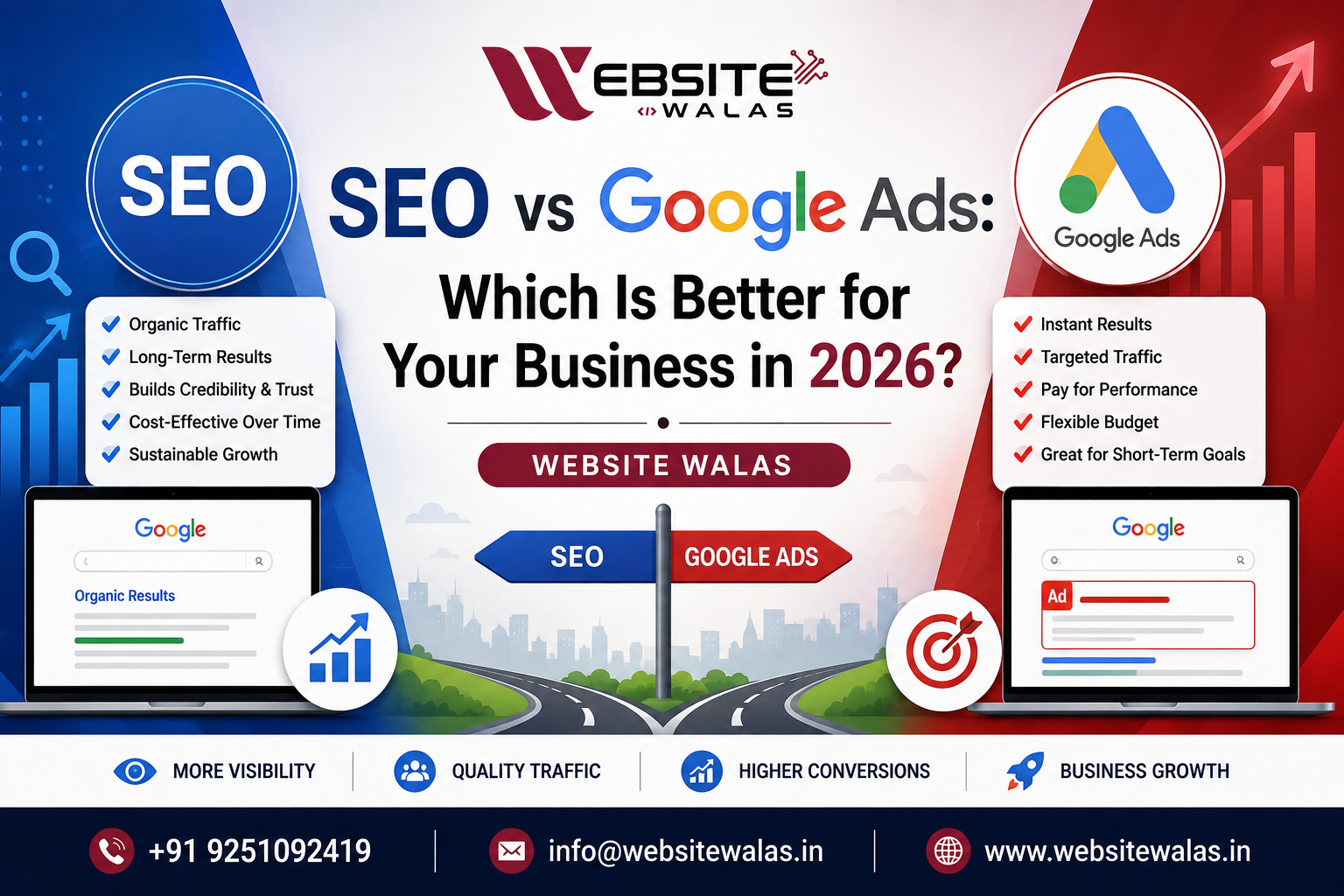
SEO vs Google Ads: Which Is Better for Your Business in 2026? | Website Walas
If you are trying to grow your business online in 2026, you have probably come across the same question: SEO vs Google Ads — which is better?
Both can bring customers to your website, but they work in very different ways.
SEO helps your website earn visibility in Google's organic search results, while Google Ads allows you to pay for targeted placements and reach potential customers quickly. One is generally a long-term investment, while the other can deliver traffic much faster when campaigns are properly set up.
So, SEO vs Google Ads: which is better for your business?
The honest answer is: it depends on your business, budget, competition, goals, and timeline. In many cases, using both together can be more effective than choosing only one.
In this guide, we'll look at the difference between SEO and Google Ads, their costs, benefits, limitations, and which strategy may make sense for your business in 2026.
What Is SEO and PPC?
Before comparing them, let's understand the basics.
What Is SEO?
SEO stands for Search Engine Optimization.
It is the process of improving your website and online presence so that search engines can better understand your content and potentially rank your pages for relevant searches.
SEO can involve:
- Keyword research
- Technical SEO
- On-page optimization
- Content creation
- Internal linking
- Website speed improvements
- Local SEO
- Google Business Profile optimization
- Competitor research
- Authority and backlink development
For example, if you own a digital marketing company in Jaipur, you might create useful content and optimize your website around relevant searches such as "digital marketing company in Jaipur" or "SEO services in Jaipur."
If your pages become competitive in organic search, they can generate visitors without paying Google for every click.
What Is PPC?
PPC stands for Pay-Per-Click.
Google Ads is one of the best-known PPC advertising platforms. With Google Ads, businesses can create campaigns that appear for relevant searches and other placements across Google's advertising network.
You generally pay when someone interacts with your advertisement according to the campaign's bidding model.
This is why people often search for SEO vs paid search, SEO vs PPC, or SEO vs paid ads when comparing the two strategies.
SEO vs Google Ads: The Main Difference
The easiest way to understand the difference is this:
SEO = Earn organic visibility
Google Ads = Pay for advertising visibility
Suppose someone searches for "best website development company in Jaipur."
With SEO, your goal is to have a relevant website page appear naturally in the organic results.
With Google Ads, you can create an advertisement that competes for available paid placements for relevant searches.
Both can put your business in front of potential customers, but the process, costs, and timelines are different.
SEO vs Google Ads Which Is Better?
There isn't one answer that works for every company.
SEO may be better when:
- You want long-term organic traffic.
- You can wait for results to develop.
- Your business has valuable informational content.
- You want to build search visibility over time.
- You want to reduce dependence on paid clicks.
- You are targeting a large group of related keywords.
Google Ads may be better when:
- You need traffic quickly.
- You are launching a new product or service.
- You have a clear advertising budget.
- Your customers are actively searching for your service.
- You want to test keywords and offers quickly.
- You have strong landing pages and conversion tracking.
Using both may be better when:
- You want immediate traffic and long-term growth.
- You want to test keywords with paid campaigns.
- You want to dominate both paid and organic search visibility.
- You want to understand customer search behavior.
- Your business has enough resources to manage both channels properly.
SEO vs Google Ads Cost
One of the most common questions is about SEO Google Ads cost.
However, comparing the two purely on price can be misleading.
With Google Ads, you typically need an advertising budget plus campaign management costs if an agency or professional is handling your campaigns.
Your advertising cost can vary based on factors such as:
- Industry
- Keyword competition
- Location
- Audience
- Ad quality
- Bidding strategy
- Search demand
- Landing-page experience
- Conversion rate
For example, highly competitive commercial keywords can be more expensive than low-competition searches.
SEO works differently.
You may spend money on:
- SEO professionals
- Content
- Technical improvements
- Website development
- Digital PR or link-building activities
- SEO tools
- Local SEO
The cost can therefore vary significantly from one business to another.
The important difference is that Google Ads spending is directly connected to your advertising activity, while SEO is an investment in improving your website's organic search visibility.
SEO vs Google Search Ads
When comparing SEO vs Google Search Ads, think about intent and timing.
Google Search Ads can put your business in front of people searching for relevant terms almost immediately after a campaign is approved and running.
SEO takes longer because your website needs to compete with other pages and build relevance and authority.
For a new business that needs enquiries immediately, Google Search Ads can be useful.
For a business that wants to build a steady source of organic traffic over time, SEO can be extremely valuable.
Google Ads vs Organic SEO
The biggest difference between Google Ads vs organic SEO is how your visibility is obtained.
Google Ads gives you paid placement.
Organic SEO aims to earn visibility through search-engine rankings.
Neither should automatically be considered "better."
Imagine you are opening a new local service business.
You could use Google Ads to generate initial traffic while simultaneously working on SEO.
Over time, your SEO pages may begin attracting organic visitors while your paid campaigns continue reaching high-intent customers.
That combination can create a more balanced acquisition strategy.
SEO vs Paid Ads: What Happens When You Stop?
This is another important difference.
If you stop running Google Ads, your paid traffic generally stops when your campaigns stop serving.
With SEO, the situation is different.
If you stop active SEO work, your existing rankings and traffic may continue for some time. However, rankings are never guaranteed permanently. Competitors can improve their websites, search behavior can change, and search engines can update their systems.
This means SEO isn't something you can necessarily "finish" forever.
Good SEO requires ongoing monitoring and improvement.
Local SEO vs Google Ads
For local businesses, the comparison becomes even more interesting.
Local SEO
Local SEO can help businesses improve visibility for searches connected with a geographic location.
For example:
- SEO services in Jaipur
- Website developer in Jhotwara
- Digital marketing agency near me
- Restaurant in Jaipur
- Dentist in Jaipur
Local SEO can involve website optimization, location-specific content, Google Business Profile optimization, customer reviews, and other local signals.
Google Ads
Google Ads can target specific locations and searches through paid campaigns.
This can be useful when you want to reach potential customers quickly.
For many local businesses, a combination of Local SEO + Google Ads can work well.
SEO can build long-term visibility, while advertising can help generate immediate opportunities.
SEO vs Google Ads for Small Businesses
Small businesses often have limited budgets, so choosing the right strategy matters.
If your business has a very small budget and can wait for results, building a strong SEO foundation may be a sensible starting point.
If you need leads immediately and have a well-designed landing page, Google Ads may provide faster opportunities.
However, don't send paid traffic to a website that isn't ready.
Before spending money on Google Ads, make sure your website:
- Loads quickly
- Works properly on mobile
- Clearly explains your service
- Has a strong call-to-action
- Provides contact options
- Builds trust
- Tracks conversions correctly
Otherwise, you may pay for visitors without generating enough enquiries.
SEO vs Google Ads for E-Commerce Businesses
E-commerce businesses can benefit from both strategies.
SEO can help with:
- Product searches
- Category pages
- Buying guides
- Informational searches
- Long-tail keywords
- Brand searches
Google Ads can help with:
- Product campaigns
- Search campaigns
- Remarketing
- Promotional campaigns
- High-intent searches
For example, an online clothing store may use SEO to build organic traffic around product categories while using paid advertising to promote products with strong conversion potential.
SEO vs PPC: Which Is Better for Lead Generation?
If your main goal is lead generation, the answer depends on the type of customer you are targeting.
Google Ads can be particularly useful when customers are actively searching for a service.
For example:
"SEO agency in Jaipur"
is a strong commercial search.
Someone using this type of query may already be considering hiring an SEO agency.
SEO can also capture these searches organically.
This is why businesses often ask SEO vs PPC which is better.
Rather than looking at traffic alone, compare:
- Cost per lead
- Lead quality
- Conversion rate
- Customer acquisition cost
- Revenue generated
- Lifetime customer value
A campaign that generates 100 cheap leads isn't necessarily better than one that generates 20 highly qualified leads.
SEO vs Google Ads Salary: Is SEO or PPC a Better Career?
Another common search is SEO vs Google Ads salary.
If you are asking this from a career perspective, both SEO and PPC can offer opportunities.
SEO professionals may work in areas such as:
- Technical SEO
- Content SEO
- Local SEO
- E-commerce SEO
- SEO strategy
- SEO analysis
PPC professionals may specialize in:
- Google Ads
- Search campaigns
- Shopping campaigns
- Conversion tracking
- Campaign optimization
- Paid media strategy
Salary varies significantly depending on experience, location, company, specialization, and ability to generate measurable results.
Rather than choosing a field based only on salary, consider which skills you enjoy developing.
Someone who enjoys technical analysis and content strategy may prefer SEO, while someone who likes data, testing, advertising, and campaign optimization may enjoy PPC.
SEO and Google Ads Course: Should You Learn Both?
If you're a student, freelancer, business owner, or aspiring digital marketer, learning both SEO and Google Ads can be useful.
An SEO and Google Ads course can give you a broader understanding of how search marketing works.
You should ideally learn:
SEO
- Keyword research
- Search intent
- On-page SEO
- Technical SEO
- Local SEO
- Content strategy
- Analytics
- Search Console
Google Ads
- Campaign structure
- Keyword targeting
- Match types
- Bidding
- Ad copy
- Landing pages
- Conversion tracking
- Performance analysis
Understanding both disciplines helps you see the complete search marketing picture.
SEO Ads Meaning: Are SEO and Ads the Same?
The phrase "SEO ads meaning" can be confusing.
SEO itself is not an advertising system.
SEO refers to improving your organic search visibility.
Google Ads is paid advertising.
Sometimes people casually call search-engine advertisements "SEO ads," but technically they are different.
A simple way to remember it:
SEO → Organic search
Google Ads → Paid search
What Does Reddit Say About SEO vs Google Ads?
You may see discussions comparing SEO vs Google Ads on Reddit and other online communities.
These discussions can be useful for understanding real-world experiences, but you should be careful about treating individual opinions as universal rules.
A business owner may say Google Ads worked extremely well for them, while another may prefer SEO.
That doesn't necessarily mean one channel is universally better.
Their industry, competition, website, budget, conversion rate, location, and customer behavior may be completely different.
Use community discussions as additional insight, not as a substitute for analyzing your own business.
Soro SEO vs Google Ads
If you come across searches such as "soro SEO vs Google Ads," the important thing is to clarify what specific SEO platform, service, or company the search refers to before making a comparison.
The broader principle remains the same: SEO focuses on organic search visibility, while Google Ads focuses on paid advertising.
Always compare actual services, pricing, features, and business objectives rather than relying on a keyword alone.
A Practical Strategy for 2026
For many businesses, the smartest approach isn't SEO vs Google Ads.
It's SEO + Google Ads.
Here's a simple strategy:
Month 1: Build the Foundation
- Audit your website
- Research keywords
- Improve important landing pages
- Set up analytics
- Set up conversion tracking
- Optimize Google Business Profile
- Launch carefully targeted Google Ads if immediate leads are required
Months 2–3: Improve Performance
- Create SEO content
- Optimize existing pages
- Test Google Ads headlines
- Improve landing pages
- Analyze search terms
- Remove poor-performing keywords
- Track leads and conversions
Months 4–6: Scale
- Expand successful SEO topics
- Build authority
- Improve local SEO
- Scale profitable ad campaigns
- Test new audiences
- Improve conversion rates
The exact timeline will vary by industry and competition, but the principle is simple: use paid advertising for speed and SEO for sustainable organic growth.
Which One Should Your Business Choose?
Here's a simple way to decide.
| Business Situation | Better Starting Point |
|---|---|
| Need leads immediately | Google Ads |
| Want long-term organic traffic | SEO |
| New website | SEO + Google Ads |
| Local business | Local SEO + Google Ads |
| E-commerce | SEO + Google Ads |
| Limited budget | SEO foundation |
| Highly competitive keywords | SEO + PPC |
| Testing a new service | Google Ads |
| Building brand authority | SEO |
| Need immediate visibility | Google Ads |
Remember that this is a starting framework, not a fixed rule.
Your actual strategy should be based on data.
SEO vs Google Ads: The Final Verdict
So, SEO vs Google Ads which is better for your business?
If you want immediate visibility, Google Ads can be a powerful option.
If you want to build organic visibility that can continue generating traffic over time, SEO is an important investment.
If you want the strongest overall search strategy, using both can often make sense.
Think of it this way:
Google Ads is like turning on a tap. You can get traffic quickly while you are paying for the campaign.
SEO is like building a road. It takes more time, but once established, it can continue bringing people to your business without paying for every individual organic click.
The best approach depends on your goals, budget, industry, competition, and customer journey.
For businesses in Jaipur looking for professional SEO, Google Ads, Local SEO, social media marketing, and website development, Website Walas can help create a strategy based on your specific business requirements.
Website Walas – Digital Marketing Services
Frequently Asked Questions
Is SEO better than Google Ads?
Not always. SEO is generally better suited for long-term organic growth, while Google Ads can provide faster paid visibility. Many businesses benefit from using both.
Is Google Ads cheaper than SEO?
Not necessarily. Google Ads requires an ongoing advertising budget, while SEO involves investment in content, technical improvements, optimization, and ongoing strategy. Costs depend heavily on the industry and competition.
What is the difference between SEO and Google Ads?
SEO focuses on organic search rankings, while Google Ads provides paid advertising placements. SEO usually takes longer to develop, whereas Google Ads can provide faster visibility.
SEO vs PPC which is better?
Neither is universally better. PPC can be useful for immediate traffic and lead generation, while SEO can be valuable for sustainable organic visibility.
Should a small business use SEO or Google Ads?
It depends on the business. If immediate leads are important, Google Ads may be useful. If the business can invest for longer-term growth, SEO is important. A combination can also work well.
Recent News


Send A Message